The Mercy That Meets Us at the Altar
Job 42:8
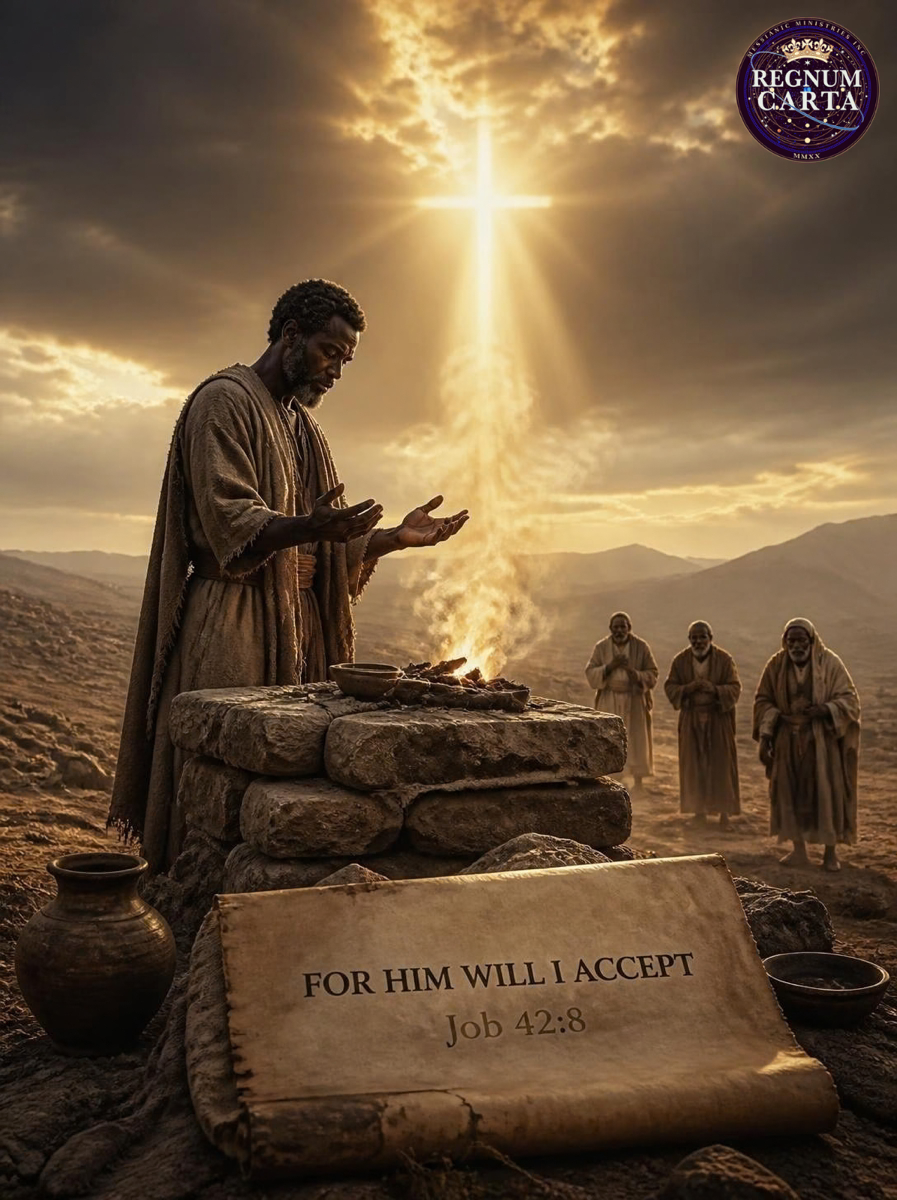
“Therefore take unto you now seven bullocks and seven rams, and go to my servant Job, and offer up for yourselves a burnt offering; and my servant Job shall pray for you: for him will I accept: lest I deal with you after your folly: for ye have not spoken of me the thing which is right, like my servant Job.” Job 42:8
Job 42:8 stands at the convergence of divine justice, human failure, intercession, sacrifice, covenant mercy, and ultimately the Messianic hope. After the long contest of words, God does not merely correct Job's friends. He establishes the necessity of sacrifice and intercession. The men who have spoken wrongly about God must approach Him through an appointed offering, and God declares that He will accept Job's prayer on their behalf.
This is more than the resolution of an ancient dispute. It reveals a theological pattern that reaches its fulfillment in Jesus Christ: sinful people require an acceptable mediator, an appointed sacrifice, and divine mercy.
Job's friends have committed theological error. Their speeches attempted to explain Job's suffering through a simplistic doctrine of retribution: suffering must correspond directly to personal sin. God rejects their representation of Him. Their theology was insufficient because it reduced divine providence to a mechanical formula.
Yet notice God's response. He does not tell them merely to improve their theology. He commands sacrifice.
The burnt offering signifies consecration, atonement, and approach to God through an appointed means. The friends cannot simply presume upon God's mercy. Reconciliation requires God's provision.
This reflects the larger covenant theology of Scripture. From Genesis onward, sinful humanity approaches a holy God through divine provision. The patriarchal sacrifices anticipate the Mosaic sacrificial system, and the Mosaic system itself points beyond animal blood toward the perfect sacrifice of Christ.
Hebrews declares:
“For it is not possible that the blood of bulls and of goats should take away sins” (Hebrews 10:4 KJV).
The sacrifices were therefore signs pointing toward something greater. Their ultimate theological significance is realized in Jesus Christ, whose sacrifice accomplishes what animal sacrifices could only foreshadow.
Job 42:8 contains a remarkable mediatorial pattern.
The friends are guilty.
A sacrifice is required.
Job is appointed to pray.
God promises acceptance.
This pattern anticipates the gospel.
Christ is simultaneously the perfect sacrifice and the perfect Mediator.
Paul writes:
“For there is one God, and one mediator between God and men, the man Christ Jesus” (1 Timothy 2:5 KJV).
Job could pray for his friends, but Job himself was not the final mediator. He was a righteous sufferer within the narrative, yet he remained a fallen human being. Jesus, however, is the sinless Son who possesses perfect righteousness and offers Himself for sinners.
Job intercedes after his suffering. Christ intercedes through His accomplished suffering.
Job's prayer is accepted because God graciously appoints him to intercede. Christ's intercession rests upon His finished redemptive work.
Hebrews therefore announces:
“He ever liveth to make intercession for them” (Hebrews 7:25 KJV).
The movement from Job to Christ is not that Job is Christ. Rather, Job participates in a biblical pattern of righteous suffering and intercession that finds its consummation in the Messiah.
Three major witnesses illuminate Job 42:8.
First, Abraham. In Genesis 18:23-33, Abraham intercedes for others before God. The patriarch stands before God pleading on behalf of people who are not present to plead for themselves.
Second, Moses. In Exodus 32:30-32, Moses intercedes after Israel's grievous sin. He appeals to God's covenant mercy rather than Israel's merit.
Third, Christ. Romans 8:34 declares that Christ “also maketh intercession for us.” What appears in patriarchal and prophetic patterns reaches its fullness in the crucified and risen Son.
The biblical trajectory is unmistakable: God repeatedly reveals His mercy through mediation, intercession, covenant, and sacrifice, culminating in Jesus Christ.
Job 42:8 confronts our tendency to speak confidently about God while understanding Him incompletely.
Job's friends had answers, but they did not have accuracy. They possessed theological vocabulary without adequate theological discernment.
That is a warning to every believer, preacher, teacher, and theologian.
We must never allow our explanation of God to become more rigid than God's revelation of Himself.
The passage also teaches us about forgiveness. God commands the very men who wounded Job with misguided accusations to seek reconciliation. Remarkably, Job becomes part of their restoration through prayer.
This is gospel-shaped spirituality.
Sometimes God heals relational wounds not by allowing us to vindicate ourselves, but by transforming us into intercessors.
The mature believer does not merely ask, “Who was wrong?” The deeper question is, “How can God's mercy be manifested here?”
Job 42:8 should not be interpreted as teaching that Job possessed intrinsic priestly power or that human beings can independently mediate salvation. The text explicitly grounds acceptance in God's declaration: “for him will I accept.”
Job's intercession is therefore derivative, not autonomous.
Likewise, the passage should not be used to establish a simplistic doctrine that every righteous person will receive material restoration in this life. Job's restoration belongs to the narrative's particular resolution and must be interpreted within the book's broader theology of suffering, divine sovereignty, and human limitation.
Most importantly, Job must not be treated as the final answer to Job. The book ultimately leaves the reader looking beyond human wisdom toward God's revelation. Canonically, that trajectory finds its fullness in Christ.
Job 42:8 whispers the gospel before the gospel is fully unveiled.
There is guilt.
There is sacrifice.
There is intercession.
There is acceptance.
There is mercy.
At Calvary, these realities converge.
Christ becomes the Lamb who bears sin, the Mediator who represents His people, the High Priest who intercedes, and the covenant sacrifice through whom sinners are reconciled to God.
The Father does not accept us because our arguments are perfect, our righteousness is sufficient, or our spiritual performance is impressive. We are accepted in the Beloved (Ephesians 1:6).
The message of Job 42:8 therefore moves from an ancient altar to the cross, from Job's intercession to Christ's eternal priesthood, and from temporary sacrificial provision to everlasting redemption.
Final Exhortation
Do not trust your own wisdom more than God's revelation.
Do not allow suffering to convince you that God has abandoned His covenant purposes.
Do not permit theological knowledge to become detached from humility, mercy, and love.
And do not approach God on the basis of your own merit.
Come through Christ.
He is the greater Mediator. He is the better Sacrifice. He is the righteous Sufferer. He is the covenant Son. He is the One whose blood speaks better things than the blood of Abel (Hebrews 12:24).
Job's friends needed an acceptable sacrifice and an intercessor. So do we.
But the good news of the New Covenant is that God Himself has provided both.
Jesus Christ is our accepted offering, our righteous Mediator, our faithful Intercessor, and our everlasting covenant hope.
Therefore, when your understanding is limited, trust Him. When your suffering is unexplained, trust Him. When others have wounded you, seek grace to intercede. And when you stand before a holy God, rest entirely in the finished work of Jesus Christ.
“For him will I accept.”
In Christ, that divine acceptance becomes the believer's living hope.
#Allnations #ame #apostolic #baptist #bible #bibleverse #catholic #christianity #christiantok # cme ##cog #cogbf #cogic #fgbcf #fght #foryou ##islam #jesus #messianicministriesinc #paw #prophetic #seventhdayadventist #tiktok #holyspirit #engagement #rastafari #ethiopian #orthodox #eritrean